Conferences

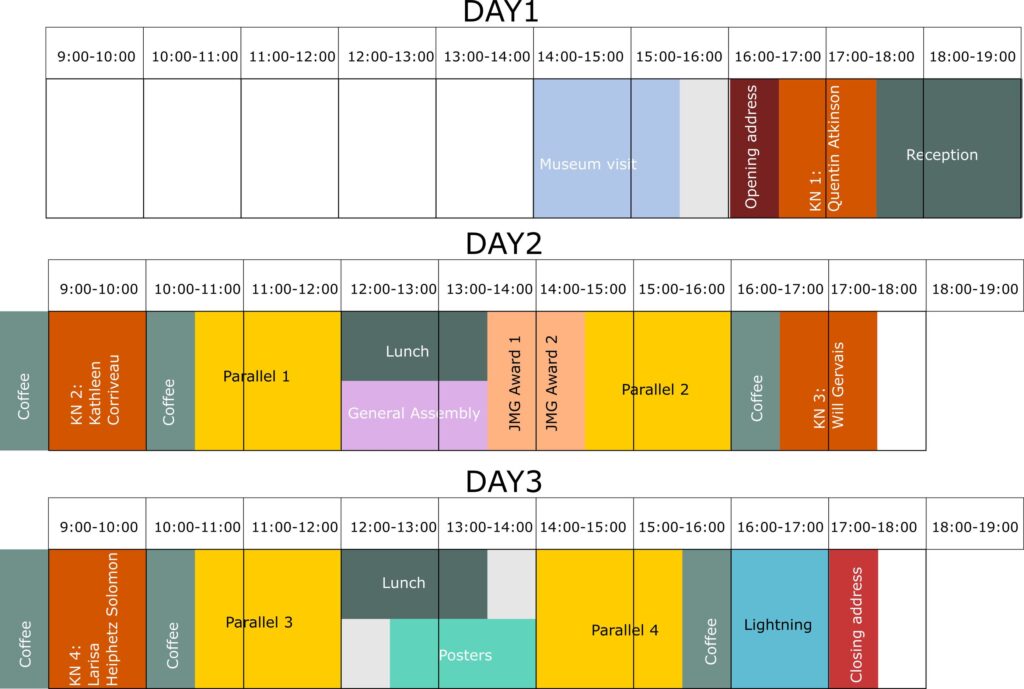
We are delighted to announce that the 10th Biennial Meeting of the International Association for the Cognitive and Evolutionary Sciences of Religion (IACESR) will be held at Masaryk University in Brno, Czech Republic, from July 1st-3rd 2026.

This event has been granted Special IAHR Conference status by the International Association for the History of Religions, recognising its thematic focus and international scholarly contribution.

We will be offering an excellent line-up of keynote speakers, events, John McGraw awards for excellent proposals by student/early career researchers and travel support thanks to a generous funding obtained from the IAHR (International Association for the History of Religions).

Call for proposals:

The Cognitive and Evolutionary Sciences of Religion is an interdisciplinary research area. We therefore encourage empirical and theoretical papers representing state-of-the-art research on religion, evolution, and cognition from all areas of the humanities, social, and natural sciences.

The call for paper and panel proposals is now open. All proposals will be submitted through Microsoft CMT. Note that while the CMT system may ask you for an ID such as ORCID or Google Scholar, these are not necessary to make a submission.

Please submit your talk abstracts here.

The call for both individual presentations and panel proposals will close February 6th, 2026. The individual presentations include individual talks and posters.
Panel abstracts can be up to 500 words while individual abstracts should be between 150 and 200 words.

Notifications of acceptance will be sent by March 8th, 2026.

John McGraw Graduate Student/Early Career Award:

This award recognises outstanding work by early career researchers. Eligibility includes current students and researchers within five years of obtaining their PhD. Awardees will be selected based on the quality of their submitted abstract; to receive the award, recipients must present their work at the conference. Awardees will be given a featured presentation slot in the programme.

Travel support for Students / Early Career Researchers:

Thanks to the support obtained from the IAHR (International Association for the History of Religions), the IACESR will be offering a limited number of scholarships to offset travel costs for graduate students and postdoctoral scholars (within 5 years of PhD). A short justification should be provided when applying for this scholarship (maximum length 200 words).

More details to follow. Information about registration will be available on our website in early 2026: https://iacesr.com/conferences/

We hope to see you in Brno!


Registration fees:

$100 USD members / $200 USD non-members 

The Microsoft CMT service was used for managing the peer-reviewing process for this conference. This service was provided for free by Microsoft and they bore all expenses, including costs for Azure cloud services as well as for software development and support.


IACESR 10th Biennial Meeting, Brno 2026: Keynote Speakers

Quentin Atkinson
Religiosity and political conservatism
Religion is frequently presented as integral to understanding conservative politics around the globe. In support of this view, countless studies have demonstrated an association between religiosity and conservative attitudes and values. Yet the nature of this relationship remains unclear. In this talk, I present a series of studies that show the association between religiosity and conservatism is both more complex and more variable than is often portrayed. This includes work examining a range of measures of religiosity and conservatism across a range of different cultural settings. I attempt to synthesise these findings to draw some general conclusions about how exactly religiosity is connected to conservatism, as well as what this means for our understanding of both religiosity and conservatism as psychological
constructs.


Larisa Heiphetz Solomon
God Concepts Across Development
Developmental science has repeatedly shown that young children do not draw strong distinctions between their own mind and God’s mind and that adults are more likely than children to conceptualize God’s extraordinary mind di@erently from humans’ ordinary minds. Meanwhile, social psychology has demonstrated cases in which adults view human minds and God’s mind similarly. I bring these two literatures together to propose that God concepts change in two ways across development. First, greater theory of mind capacities allow adults, versus children, to draw stronger distinctions between human minds and God’s mind in many cases. Second, when adults do view these two types of minds similarly, they may do so for a di@erent reason than children. Thus, a developmental perspective in useful not just
in examining similarities or di@erences across age but also in understanding consistency or change in the underlying mechanism. Such a perspective can also shed light on how shifting God concepts can a@ect cognition and behavior.


Will Gervais
Belief in Belief and Hidden Heathens: What Self Reports Aren’t Telling Us About (Ir)Religious Cognition
Most folks on earth say they believe in a god of some sort — but many of them are concealing private religious doubts. Many atheists say they’ve got no need for religion — but many of them harbor subtle pro-religious intuitions that Dennet might call “belief in belief.” In this talk, I want to ask: What’s the deal? When (and why) do self-reports both over- and under-estimate religious commitment? And how do the answers to these questions impact our theorizing on the cognitive, cultural, and evolutionary bases of religious belief and disbelief? I don’t have the answers, but it’ll be fun, y’all.


Rebekah Richert
[Title and Abstract TBC]


Practical information

Getting to Brno:
Brno is the second-largest city in the Czech Republic and is well-connected to major Central European transport hubs. The city can be reached directly via flight through some ports or easily by train or long-distance bus from nearby international airports and capitals such as Prague, Vienna, and Bratislava.

Flying Directly to Brno
The main airport in Brno is the Brno–Tuřany Airport, which is located approximately 8 km from the city centre. From the airport, travellers can reach the centre of Brno in about 20–25 minutes by public transport or taxi. For more information on how to travel via public transport in Brno, visit this site: https://www.pipniajed.cz/en.html

Direct flights to Brno are limited and often seasonal, but the airport typically offers connections to destinations such as:
• London, United Kingdom (Stansted Airport) – operated by Ryanair
• Bergamo, Italy – operated by Ryanair
• Malaga, Spain – operated by Ryanair
• Rome, Italy – operated by AeroItalia
• Tivat, Montenegro and Podgorica, Montenegro – operated by Air Montenegro
Seasonal and charter flights (typically in summer, so during the time of the conference) may also operate to destinations such as:
• Antalya, Turkey
• Marsa Alam, Egypt
• Heraklion, Greece
• Rhodes, Greece
• Hurghada, Egypt
However, the number of direct flights is limited, so it is best to check and plan beforehand. Alternatively one can arrive to one of the three major ports listed below via flight and then arrive from there to Brno via train or bus.


From Vienna, Austria
Many international visitors arrive via Vienna International Airport, the closest large international airport to Brno.

By Bus
Direct buses run from Vienna Airport, Austria and Vienna city centre, Austria to Brno.
Common operators include:
• FlixBus
• RegioJet
Travel time: about 1 hour 45 minutes to 2 hours.

By Train
While there is no direct train from Vienna Airport to Brno, the airport is very well connected to Wien Hauptbahnhof (Vienna Central Station), which serves as the main hub for trains to Brno.

Travellers can take a direct train from Vienna Airport to Wien Hauptbahnhof, which runs frequently throughout the day, and takes only 15 minutes.From Wien Hauptbahnhof, travellers can take a direct train to Brno hlavní nádraží.
Common train operators include:
• ÖBB
• RegioJet
• České dráhy
Travel time: approximately 1 hour 30 minutes.

From Prague, Czech Republic
From Prague there are many busses and trains that reach Brno. The easiest way from Václav Havel Airport Prague to Brno is via bus.

By Bus
Direct buses connect Prague Airport with Brno.
Common operators include:
• FlixBus
• RegioJet
Travel time: approximately 2.5–3.5 hours.

By Train
Trains run frequently between Praha hlavní nádraží and Brno hlavní nádraží.
It is important to note that Praha hlavní nádraží is located in the city centre of Prague and not at the airport. Travellers arriving at Prague Airport must first take a bus, airport shuttle, or taxi to the city centre railway station before continuing by train to Brno.
Major train operators include:
• České dráhy
• RegioJet
Travel time: approximately 2.5 hours.

From Bratislava, Slovakia
Another nearby airport is M. R. Štefánik Airport, in Slovakia.

By Bus
Direct buses operate between Bratislava, Slovakia and Brno, Czech Republic.
Common operators include:
• FlixBus
• RegioJet
• Slovak Lines
Travel time: about 1.5–2 hours.

By Train
There is no direct train from the airport to Brno, but the airport is located only about 9 km from the city centre and is well connected to Bratislava hlavná stanica.
Travellers arriving at the airport can reach the main railway station by bus or taxi in approximately 20–30 minutes, and then continue to Brno by train.
Common operators include:
• RegioJet
• České dráhy
• ÖBB
Travel time: approximately 1 hour 40 minutes